
DIY Projects Soil & garden
Make Your Own
Compost Tea
Learn what compost tea can offer, make a small stirred batch, and use it thoughtfully in a non-edible ornamental garden.
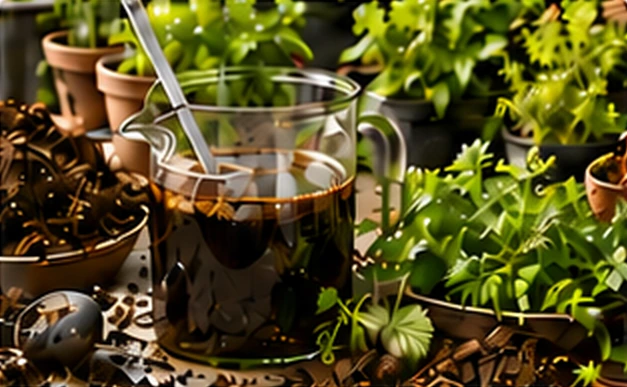
- Project
- A small garden experiment
- Brewing time
- 48 hours, with stirring
- Where to use it
- Soil around non-edible ornamentals
Turning garden materials into something useful is part of the appeal of composting. Compost tea takes that idea into a bucket: finished compost is steeped in water, and the liquid is used in the garden.
It can carry dissolved nutrients, but its composition is unpredictable. A homemade batch is best approached as an experiment, rather than a dependable substitute for a fertiliser programme or a soil test. [3][5]
01 / Understand the process
What is compost tea?
Gardeners use the name for several water-based compost preparations. Some are stirred occasionally; others are continuously aerated with a pump. Those methods create different conditions for microorganisms, so results from one preparation cannot simply be assumed for another. [4]
This guide follows a stirred, 48-hour extraction method. It is not an actively aerated brewing system. It is also different from leachate—the drainage from a compost heap or worm bin, which may have passed through unfinished material. Do not substitute that drainage for the ingredients below. [1][7]
What the evidence supports
- Nutrient content varies. A strawberry study found that the teas supplied many nutrients, but solid compost and fertiliser supplied more potassium. That finding does not establish a reliable nutrient recipe for a household batch. [3]
- Disease control is inconsistent. Published extension reviews describe variable results. Do not use this project as a treatment for an unidentified plant disease. [4][5]
- More microbial growth is not automatically better. In controlled research, nutrient supplements supported growth of E. coli and Salmonella in both aerated and non-aerated tea. [2]
02 / Choose an appropriate use
Before you start
PUREARTH takes a conservative approach for a home project: use this preparation only on soil around non-edible ornamental plants. Keep it away from vegetables, herbs, fruit, edible flowers, and any plant parts you plan to eat. This restriction is an editorial precaution based on the contamination concerns in the sources—not a claim that the recipe has been safety-tested. [2][4]
Brewing does not sanitise compost
Start with mature compost from a source that can explain how it was produced and handled. A dark colour or earthy smell does not prove that harmful microorganisms are absent. Use clean equipment and potable water; leave out raw manure, pet waste, molasses, sugar, and other brewing supplements. [2][4][7]
If the compost’s history is uncertain, skip the liquid experiment. Improving your composting process or choosing an appropriate, clearly labelled soil amendment is a more useful next step.
03 / Keep the setup simple
Gather your materials
For one small batch, set aside:
- 500 mL of mature compost, measured by volume. For this home project, choose a plant-based compost with a known production history.
- 5 L of potable water, without chlorine or chloramine. See the Hamilton water note below.
- A clean bucket of at least 10 L capacity, never used for pesticides or other hazardous chemicals.
- A fine-mesh fabric bag, a support stick, a stirring tool, and a watering can.
- Gardening gloves, a thermometer, and a note of the starting date and time.
Method adapted from NC State Extension; hygiene follows University of Vermont guidance. [1][4]
04 / The practical method
Make a small batch
These steps describe extraction, not a proven way to manufacture a disease treatment or a pathogen-free fertiliser. The non-edible, soil-only limits above apply throughout.
Prepare the equipment
Clean and sanitise the bucket, bag, stirring tool, and watering can. Follow the sanitising product’s directions, including any rinsing instructions. Wash your hands after handling compost. [4]
Measure and suspend
Add 5 L water to the bucket. Put 500 mL compost in the mesh bag, submerge it, and secure it to a stick across the top.
Choose a sheltered position
Keep the bucket out of direct sun at 16–27°C. Exclude debris and keep children and pets away. Record the starting time.
Stir over 48 hours
Stir the liquid 12 times over the next 48 hours. Do not add sugar, molasses, or other supplements. If you cannot maintain the conditions, choose direct compost use instead.
Remove the compost bag
At 48 hours, lift out the bag and transfer the liquid to the clean watering can. Do not taste it or use a spray bottle.
Use promptly, then clean up
Use immediately, and within four hours of finishing. Do not bottle it for later. Clean the equipment and wash your hands.
Follow the home-use restrictions above. This adaptation is not a validated safety protocol. [1]
05 / Apply thoughtfully
Use it on the soil. Keep expectations realistic.
Apply gently to soil around a small area of non-edible ornamental plants, without splashing foliage or creating runoff. Treat it as part of the watering the plants actually need, rather than adding liquid to already saturated soil. Do not pour it onto paths or into storm drains.
There is no measured N–P–K analysis for your bucket, so a fixed “feed every week” instruction would imply more certainty than the preparation allows. Do not use it to correct a suspected deficiency without checking the soil and the plant’s requirements. [3][6]
Make it a learning exercise
Keep a similar group of ornamentals on their usual care and water alone. Record what you applied, the weather, and visible changes. Keep other care as consistent as practical. A greener plant after watering is an observation—not proof that compost tea caused the improvement. [5]
06 / Build the foundation
Often, finished compost is the better project
Using mature compost directly retains the solid organic matter that helps improve soil structure and water management. Use a suitable amount as a soil amendment or surface dressing, guided by your soil conditions and test results. Growing in pure compost, or repeatedly adding large quantities, can create nutrient or salt problems. [6]
For a Hamilton starting point, the City’s backyard composting guide explains how to manage a pile and use the finished material. Building a simple composting routine may do more for your garden than adding a brewing routine. [10]
07 / Common questions
A few things worth knowing
Can I use this tea on vegetables or herbs?
Not under this home-project guide. Its deliberately conservative scope is soil around non-edible ornamentals. Moving the liquid to the soil does not, by itself, establish that an edible crop is protected from contamination. [2][7]
Does an air pump make it safe?
No. Aeration changes the oxygen conditions; it is not a sanitising treatment. Research documented growth of human pathogens in aerated tea when nutrient supplements were included. [2]
Is liquid from the bottom of a worm bin the same thing?
No. That is leachate, not the deliberately prepared extraction described here. Do not use it as an ingredient or a substitute for this batch. [7]
The most useful outcome is a better understanding of your garden. Keep the experiment modest, be honest about what it can show, and let careful soil care do the everyday work.
Read the evidence
Sources & further reading
Original PUREARTH writing, informed by the publications below. Sources checked October 18, 2026. University methods differ; this guide does not claim that any household batch is proven safe or effective.
- NC State Extension — Extension Gardener Handbook: CompostingPractical source for the 1:10 ratio, 48-hour stirred method, temperature range, and four-hour use window.
- Ingram & Millner (2007) — Factors Affecting Compost Tea as a Potential Source of Escherichia coli and Salmonella on Fresh ProducePeer-reviewed study, Journal of Food Protection, 70(4), 828–834. DOI: 10.4315/0362-028X-70.4.828.
- Hargreaves and colleagues (2009) — Are compost teas an effective nutrient amendment in the cultivation of strawberries? Soil and plant tissue effectsPeer-reviewed nutrient study. DOI: 10.1002/jsfa.3456. Its specific results are not a universal home-garden recipe.
- University of Vermont Extension — Compost Tea to Suppress Plant DiseaseVern Grubinger, 2005. Explains variable results and precautions concerning water, equipment, and additives. Historical US certification discussion is not used as Canadian regulatory advice.
- Washington State University — Compost tea: Examining the science behind the claimsLinda Chalker-Scott, 2007. Evidence assessment and principles of controlled observation. PDF.
- UConn Extension — How to Get Started with Composting at Home: A Practical GuidePublication EXT206, April 2026. Compost maturity, appropriate use, soil testing, and risks of excess applications.
- Cornell University — Soil AmendmentsDefinitions of teas and leachates, hygiene, and produce-contamination concerns. US farm guidance informs the science, not local legal requirements.
- City of Hamilton — 2025 Drinking Water Systems Annual Water Quality and Summary ReportWoodward subsystem treatment description, printed pages 7–8. PDF.
- US Environmental Protection Agency — How can I remove monochloramine from my drinking water?Explains why standing water does not remove monochloramine and how to identify treatment products. PDF.
- City of Hamilton — Backyard CompostingLocal instructions for composting materials, pile care, and using finished compost.